

Label Printer Applicator Machines Market to Reach USD 1.60 Billion by 2033, Growing at 4.5% CAGR as Inline Automation and Traceability Compliance Reshape Packaging Lines - Verified Market Research
Global demand for automated print-and-apply labeling systems is accelerating as manufacturers replace manual workflows with automatic and semi-automatic solutions to reduce mislabeling risk and improve line throughput. The Label Printer Applicator Machines Market is expanding on the back of regulatory traceability requirements, thermal and ink-based print technology advances, and rising automation intensity across packaging, pharmaceuticals, food and beverages, consumer goods, and automotive supply chains. North America leads global adoption with an estimated 35% market share, while Asia Pacific reflects the fastest-scaling industrial demand base. Verified Market Research® projects the Label Printer Applicator Machines Market Size will climb steadily through 2033, underpinned by measurable operational efficiency gains rather than a single disruptive catalyst.
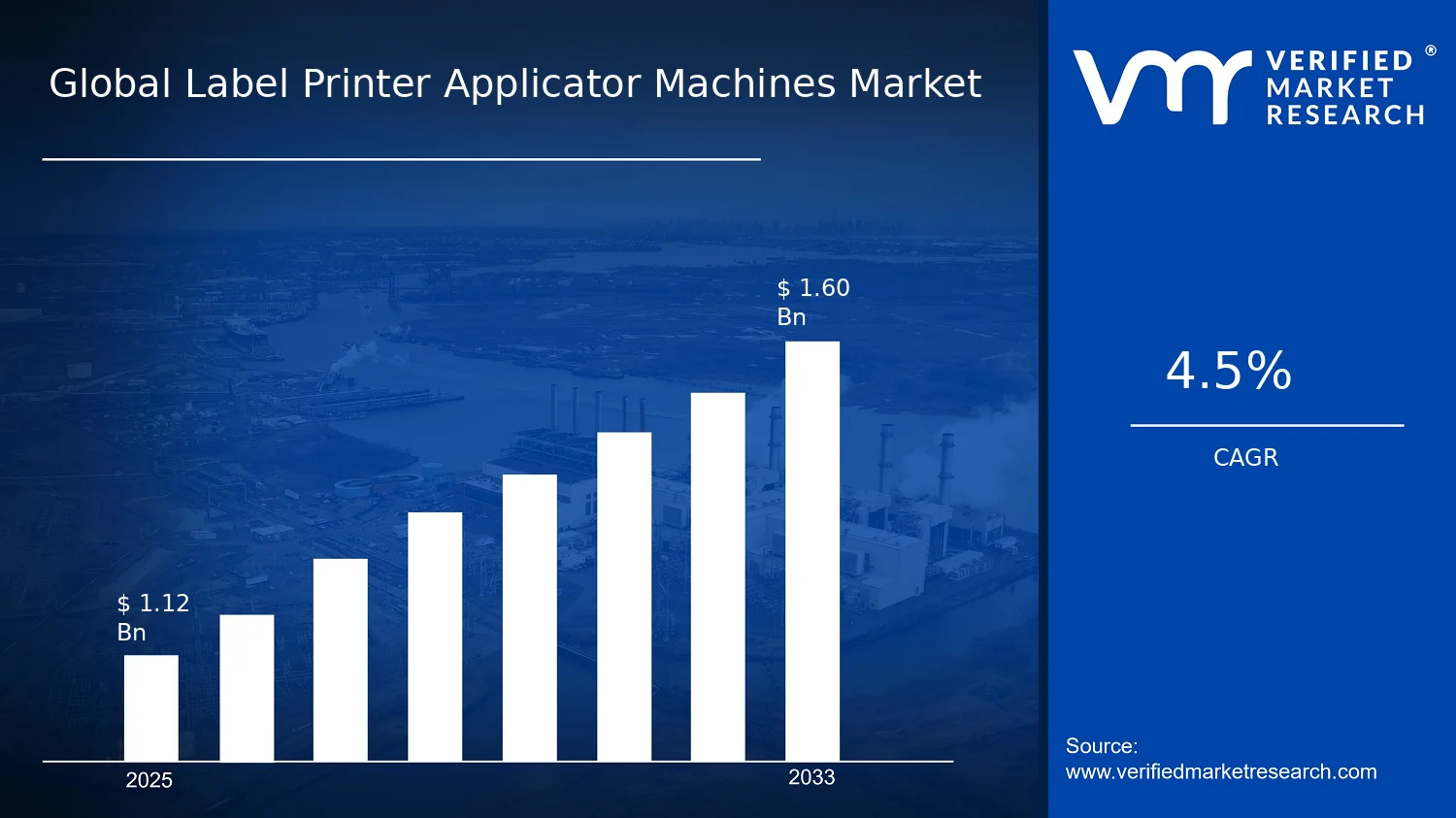
LEWES, Delaware, Aug. 07, 2026 (GLOBE NEWSWIRE) -- The Global Label Printer Applicator Machines Market was valued at USD 1.12 Billion in 2025 and is projected to reach USD 1.60 Billion by 2033, expanding at a Compound Annual Growth Rate (CAGR) of 4.5% over the 2025–2033 forecast period, according to a new industry analysis released by Verified Market Research®. The report segments the Label Printer Applicator Machines Industry By Type (Automatic Label Printer Applicators, Semi-Automatic Label Printer Applicators, Manual Label Applicators), By Print Technology (Thermal Transfer, Direct Thermal, Inkjet), By Application (Packaging And Logistics, Food And Beverages, Pharmaceuticals, Consumer Goods, Automotive), and By Geography, with coverage spanning five regions, three equipment types, three print technologies, five applications, and ten key industry players.
Download a free sample to access exclusive Insights, Data Charts, And Forecasts From Label Printer Applicator Machines Market Sample Report
The Label Printer Applicator Machines Market Growth outlook reflects steady, operationally driven expansion rather than a single disruptive shift. Automatic label printer applicators currently represent the dominant equipment type, favored for inline integration and uptime priorities on high-speed packaging lines, while North America maintains regional leadership with approximately 35% market share, supported by early automation adoption and a concentration of strongly regulated end-use industries.
Market Overview: Defining the Label Printer Applicator Machines Market
The Label Printer Applicator Machines Market is defined around equipment systems that apply printed labels onto products, packages, or components with controlled placement accuracy and repeatable throughput. Participation in this market is limited to label printer applicator machines and closely associated configurations that integrate printing capability with applicator or dispense mechanisms, meaning the label is produced and then applied as part of a single operational workflow. The primary function covered by the market is in-line or near-line label generation and application for identification, compliance, and logistics traceability across industrial and consumer supply chains.
In scope, the Label Printer Applicator Machines Industry includes systems where the label is printed using supported print technologies and then applied using applicator mechanisms designed for production environments, translating print content into a finished applied label on substrates such as cartons, bottles, cases, pouches, or automotive parts. The market is structured around three mutually reinforcing dimensions: how the applicator is operated (type), how the printing is achieved (print technology), and where labeling is used within the production or distribution context (application).
To eliminate ambiguity, the report explicitly excludes several adjacent categories that are commonly searched alongside label printer applicator machines but do not meet the market's inclusion logic. Standalone label printers without an integrated applicator or dispense workflow are excluded, since the core differentiator of this market is the combined print-and-apply system. Label applicators used without printing capability are also excluded, even where they support high-accuracy placement, because they do not deliver the integrated operation that defines this market. Similarly, printing-only or generic marking solutions, such as general-purpose industrial coding systems that mark directly on surfaces without label application, fall outside the scope because their value-chain position and end-use output differ materially from applied labels.
Label Printer Applicator Machines Market Growth Explanation
The Label Printer Applicator Machines Market outlook is primarily shaped by the cause-and-effect relationship between faster production schedules and the operational need for consistent label placement. As packaging lines increase speed, label application becomes a bottleneck, and automated label printer applicator machines reduce human handling variability that can contribute to incorrect placement and rework. This effect is amplified by traceability expectations that require legible printing, stable adhesion, and repeatable alignment across batches.
Technology transitions also support sustained Label Printer Applicator Machines Market growth. Direct thermal systems are increasingly used where short-life labels and reduced consumables costs are priorities, while thermal transfer remains relevant for applications requiring improved durability and readability over time. Inkjet adoption, meanwhile, is associated with the growing need for dynamic, data-driven printing, such as changing production dates and batch identifiers, without maintaining a large inventory of pre-printed labels.
Regulatory and public-health compliance further reinforce adoption in regulated end markets. Pharmaceutical serialization and traceability programs in major markets have increased the volume and complexity of labeling data, aligning with the operational strengths of applicator-equipped workflows. In addition, labeling requirements tied to food safety and distribution logistics encourage organizations to standardize print-and-apply operations to reduce errors across shifting supply nodes. As a result, the market is expected to expand steadily across both automation levels and print technologies, with demand growth closely following the migration of labeling from manual tasks to controlled industrial processes.
Download a free sample to access exclusive Insights, Data Charts, And Forecasts From Label Printer Applicator Machines Market Sample Report
Key Growth Drivers Shaping the Label Printer Applicator Machines Market
Inline Labeling Automation Reduces Downtime and Rework
As manufacturers move toward faster packaging, warehousing, and dispatch cycles, label printer applicator machines equipped with sensing and controlled feed rates reduce misalignment and reprint events. This transforms labeling into a controllable part of the production line rather than a downstream fix. The result is broader deployment of automatic label printer applicators on high-throughput lines, increasing installed-base replacement cycles and supporting steady Label Printer Applicator Machines Market growth.
Regulatory Compliance for Traceability Strengthens Standardized Adoption
Compliance requirements demanding consistent identification, legibility, and audit-ready labeling push plants to reduce variability between batches and shifts. Label printer applicator machines enable repeatable placement and stable print characteristics by synchronizing label application with production execution. Fewer nonconformities lead to higher line utilization and lower inspection escalations, sustaining investment in compliant labeling equipment across regulated applications such as pharmaceuticals and food and beverages.
Thermal and Ink-Based Print Technology Advances Lower Operating Costs
Incremental improvements in print head performance, media handling, and ink or ribbon durability improve uptime and reduce per-label consumable waste. Combined with better label application control, these advances allow firms to support more SKUs and promotional variants without redesigning entire lines. This flexibility drives demand for machines capable of reliably applying changing label formats, expanding purchase intent across both consumer-facing and logistics-heavy operations.
Ecosystem-Level Drivers Reinforce Core Demand
The broader Label Printer Applicator Machines Market ecosystem is being reshaped by faster supply-chain integration and more standardized labeling workflows across OEMs, converters, and system integrators. Capacity expansions in packaging and distribution facilities increase the number of labeling touchpoints per unit of output, while consolidation among automation integrators concentrates project-delivery capabilities. Improvements in installation and distribution networks reduce lead times for equipment and spare parts, lowering adoption friction and amplifying core drivers across the market.
Emerging Opportunities in the Label Printer Applicator Machines Market
Several opportunity clusters are emerging within the Label Printer Applicator Machines Industry, each grounded in measurable operational outcomes rather than speculative demand.
- Automation retrofit plays for fast payback in Packaging and Logistics: Upgrading from manual or semi-automatic applicators to automatic systems on existing packaging lines offers measurable throughput and labor-cost benefits without requiring full line redesign.
- Compliance-grade labeling workflows for Pharmaceuticals: Integrating traceable printing and application behavior supports serialization and strict readability requirements, rewarding suppliers that pair precision engineering with verification-ready documentation.
- High-variance SKU capability for Food and Beverages and Consumer Goods: Label application systems built for frequent changeovers, varied pack shapes, and different label materials address the rising cost of manual handling and slow setup driven by SKU proliferation.
- Print technology specialization for material performance and lifecycle cost: Tuning thermal transfer, direct thermal, or inkjet selection to substrate behavior and durability requirements supports premium positioning when paired with verifiable performance.
- Service-led uptime and supply chain optimization: Standardized spare kits, preventive maintenance, and negotiated consumables programs reduce total cost of ownership and strengthen customer retention across high-volume labeling lines.
Beyond these clusters, the market opportunity extends to underpenetrated regulated and label-intensive categories. Pharmaceutical and food and beverage production environments increasingly require consistent label placement, stable performance under validation, and predictable outcomes during formulation or packaging revisions, creating a mismatch between existing line capabilities and the operational rigor expected by quality systems. Label printer applicator machines that support tighter process control and integration into traceability workflows can displace fragmented manual practices, translating into competitive advantage for vendors that align equipment capability with validation-oriented buyer decision criteria.
Download a free sample to access exclusive Insights, Data Charts, And Forecasts From Label Printer Applicator Machines Market Sample Report
Market Challenges and Restraints
Regulatory and Labeling Compliance Complexity
Label Printer Applicator Machines Market adoption faces frequent procedural requirements for traceability, readability, and validation of labeling processes. In regulated facilities, production lines cannot easily switch equipment or print parameters without documentation, requalification, and audit readiness, which increases downtime risk during installation and extends decision timelines from pilot to rollout. As a result, buyers often delay scaling and retain legacy configurations, moderating demand growth in higher-compliance applications such as pharmaceuticals and food manufacturing.
Rising Total Ownership Costs
Even where acquisition prices are manageable, profitability within the Label Printer Applicator Machines Industry can be constrained by recurring costs for print media, adhesives, cleaning, calibration, and service access. Operational friction becomes more pronounced when labels must meet strict adhesion, durability, or format consistency under varying line speeds. Elevated defect rates translate into scrap and rework penalties that can outweigh productivity gains, prompting procurement teams to postpone automation upgrades where budgets are constrained and ROI payback periods are tightly controlled.
Integration and Performance Variability at Higher Line Speeds
Automated labeling depends on stable synchronization between print modules, applicators, conveyors, and inspection systems. Variability in label stock, substrate surface behavior, and environmental conditions can create misalignment, reduced scan reliability, or inconsistent dispense issues that become more visible as lines run faster and more label formats are introduced. Where engineering effort required to tune setups is high, buyers may restrict automation scope, prefer manual or semi-automatic solutions, or reduce utilization rates, constraining scalable expansion.
At the ecosystem level, supply-chain bottlenecks in label materials, spare parts, and technician availability can lengthen lead times and extend recovery after downtime events. Fragmentation in component standards and limited interoperability across vendors increase integration effort, while capacity constraints in local service networks and regional regulatory interpretations reinforce adoption delays and complicate multi-site rollouts across the Label Printer Applicator Machines Market.
Technology and Innovation Trends
Technology within the Label Printer Applicator Machines Market functions as a capability engine that influences how accurately labels are placed, how efficiently lines run, and how readily new packaging formats can be adopted. Evolution in this space mixes incremental reliability improvements with more consequential shifts in printing flexibility, application control, and compatibility with diverse label materials.
Application Control That Stabilizes Placement Across Variable Pack Geometries
Label application systems are evolving toward tighter control of where a label lands as package surfaces vary in size, shape, and material. Improvements in motion coordination and feedback-driven alignment help systems maintain consistent placement despite product-mix changes, strengthening line resilience during high-mix production and enabling broader deployment of automatic and semi-automatic label printer applicators in packaging and logistics, consumer goods, and automotive components.
Print-Method Compatibility for Durable Labeling
Innovation in the printing layer focuses on managing print technologies to ensure label durability and legibility across temperature, friction, and storage timelines that differ by application. Thermal transfer can support workflows requiring label permanence, while direct thermal fits environments where handling sensitivity is managed operationally. Inkjet-enabled workflows address limitations tied to static label runs by supporting variable imprint needs, reducing label failures and simplifying changeovers in pharmaceuticals and food and beverages.
Higher-Throughput Integration Through Workflow-Aware Automation
Labeling systems are increasingly designed to coordinate label handling, printing, and application steps as a unified workflow rather than isolated processes, targeting downtime during format transitions and variability in label supply management. Reduced changeover friction combined with smoother operation in mixed batches allows automatic label printer applicators to scale across longer production windows, supporting adoption patterns in packaging and logistics and broadening feasibility in automotive labeling.
Industry Use Cases and End-User Applications
Application context within the Label Printer Applicator Machines Market determines how labels are designed and applied, whether functioning primarily as logistics identifiers, ingredient and regulatory carriers, or end-market branding elements.
Packaging and Logistics
Packaging and logistics operations form the core demand base for the market, since label placement is integral to warehouse handling, distribution compliance, and shipment identification. Conveyor-based carton and case labeling for parcel and fulfillment flows requires scannable identifiers attached at line speed without disrupting downstream sorting, favoring systems that deliver stable print quality and controlled dispensing under throughput pressure.
Food and Beverages
Food and beverage deployments focus on label durability and process compatibility, where labels must withstand handling, temperature variations, and packaging line conditions while maintaining scan-ability for sorting and downstream verification. Recipe, ingredient, and compliance labeling on food and beverage packaging requires consistent alignment on curved or irregular surfaces, with demand strengthening when plants require frequent formatting changes due to seasonal variants or multiple pack sizes.
Pharmaceuticals
Pharmaceuticals rely on labeling operations that support compliance, traceability, and production documentation discipline. Labeling of pharmaceutical packs where traceability and controlled application processes are operationalized reflects a setting where documentation and procedural consistency matter as much as the physical label, increasing the importance of dependable alignment and repeatable application behavior that sustains legibility under expected handling and inspection conditions.
Consumer Goods
Consumer goods applications place greater emphasis on branding consistency, label durability, and presentation across high-mix supply chains. SKU proliferation and brand-driven labeling requirements increase the need for flexible, quickly adaptable application systems capable of handling changing label formats while maintaining unit-level accuracy.
Automotive
Automotive environments commonly require robust labeling under industrial conditions and integration into broader manufacturing processes, where timing and workflow alignment are critical. Demand expands as plants standardize identification workflows across suppliers and internal production stages, increasing the need for repeatable application at scale.
Download a free sample to access exclusive Insights, Data Charts, And Forecasts From Label Printer Applicator Machines Market Sample Report
Label Printer Applicator Machines Market Segmentation
By Type
- Automatic Label Printer Applicators - the dominant segment, aligned with continuous operation, automated feeding, and application control for high-throughput environments where uptime and precision are critical.
- Semi-Automatic Label Printer Applicators - representing a midpoint involving partial operator interaction while supporting machine-controlled application steps that reduce variability compared with manual handling.
- Manual Label Applicators - concentrated in lower-volume or highly customized production where operational scale, footprint constraints, or batch formats favor manual or operator-assisted application.
By Print Technology
- Thermal Transfer - used where specific durability or material compatibility is required, supporting label permanence across handling and storage conditions.
- Direct Thermal - commonly selected for fast-turn labeling needs and reduced consumable complexity, fitting shorter label lifecycle requirements.
- Inkjet - supports data-variable printing requirements, enabling dynamic labeling for changing production dates, batch identifiers, and promotional content.
By Application
- Packaging And Logistics
- Food And Beverages
- Pharmaceuticals
- Consumer Goods
- Automotive
By Geography
- North America
- Europe
- Asia Pacific
- Latin America
- Middle East & Africa
Regional Outlook
North America
North America is characterized by steady replacement and upgrade cycles alongside selective line expansion, particularly in packaging and logistics, pharmaceuticals, and food processing. Demand is supported by a large base of brand owners, contract manufacturers, and large-scale retail distribution networks requiring consistent label placement, legibility, and operational uptime. The region maintains approximately 35% market share, driven by early automation adoption and a concentration of strongly regulated industries. Compliance expectations around traceability and controlled handling of regulated products influence equipment specifications, including print durability and changeover efficiency, while a mature industrial base and innovation ecosystem in automation and industrial printing support faster trials of automatic and semi-automatic applicator configurations.
Europe
Europe's Label Printer Applicator Machines Market is shaped by regulatory discipline, documentation requirements, and a strong expectation of traceability across packaging and labeling workflows. EU-wide harmonization drives consistent technical specifications, favoring standardized applicator performance, predictable changeover times, and validated print quality. The region's highly integrated industrial base and cross-border production networks increase pressure to run uniform label formats across plants, supporting automation and data-ready setups. European purchasing decisions tend to prioritize certification readiness and quality assurance over purely cost-led procurement, particularly in pharmaceuticals and food and beverages.
Asia Pacific
Asia Pacific reflects a high-growth, expansion-driven industrial cycle, with demand pulled by packaging modernization and broader product-range scaling. Growth rates vary between Japan and Australia, where upgrades emphasize compliance, line efficiency, and print quality, and markets such as India and parts of Southeast Asia, where capacity buildout and new plant commissioning accelerate adoption. Rapid industrialization, urbanization, and population scale support high-throughput requirements across food and beverages, pharmaceuticals, and consumer goods, with the region remaining structurally fragmented as sector maturity and automation intensity differ materially by country and end use.
Latin America
Latin America represents an emerging yet gradually expanding segment of the Label Printer Applicator Machines Market, with demand anchored in Brazil, Mexico, and Argentina. Industrial activity in packaging and logistics, food and beverages, and pharmaceuticals supports recurring use cases, while capital spending and production volumes remain sensitive to economic cycles. Currency volatility can affect procurement timing for equipment and consumables, and an uneven industrial base combined with infrastructure constraints influences how quickly printers are adopted, producing uneven growth by country and application.
Middle East & Africa
The Middle East & Africa segment is characterized by selective development rather than uniform expansion. Demand is shaped disproportionately by Gulf economies, where large-scale logistics, retail, and manufacturing modernization drives automation, while countries such as South Africa and a smaller set of industrial hubs form slower, procurement-cycle-driven growth. Infrastructure variation, import dependence for label stocks and system components, and differences in institutional procurement practices create uneven industrial readiness, concentrating opportunity around urban corridors, strategic public-sector programs, and export-linked sectors.
Competitive Landscape
The Label Printer Applicator Machines Market competitive landscape is best characterized as moderately fragmented, with a mix of platform suppliers, automation integrators, and specialized labeling equipment companies. Competition tends to center on total cost of ownership rather than machine price alone, particularly where uptime, print consistency, and maintenance cycles affect line throughput in packaging and logistics, pharmaceuticals, and food processing.
- ProMach - a systems-oriented supplier and line partner that embeds label printer applicator machines into end-to-end packaging lines, coordinating upstream and downstream handling for consistent label placement and fewer changeover issues. ProMach leads the market due to its end-to-end packaging integration and commissioning support for repeatable label application.
- Weber Packaging Solutions - a solutions provider emphasizing packaging-line engineering and end-of-line capability, aligning label application hardware with packaging line realities such as web or case flow and labeling station constraints.
- Videojet Technologies (Danaher) - a technology-focused supplier emphasizing printing systems and traceability-oriented deployments, centered on print quality assurance, variable-data capability, and inspection-driven processes.
- Domino Printing Sciences - a solutions provider with a strong technology and application emphasis, pushing toward improved legibility under varying operational conditions and enhanced data integrity for compliance workflows.
- Herma GmbH - a labeling specialist with strong application know-how, emphasizing precision label application, applicator mechanics, and stable operation across common packaging substrates.
- Markem-Imaje (Dover Corporation) - contributing industrial coding and print technology integration expertise.
- Quadrel Labeling Systems - reflecting regionally grounded capability and practical deployment experience in labeling lines.
- Label-Aire - aligned with specialized application delivery and engineering support for tailored setups.
- ALTech UK - providing specialized application delivery and engineering support where operational constraints require tailored configurations.
- EPI Labelers - reflecting regionally grounded capability and practical deployment experience within labeling operations.
Collectively, these participants sustain competitive pressure by preserving options across automation maturity levels, including manual and semi-automatic label applicator adoption where budgets and line complexity are limiting factors. Over the 2025 to 2033 period, competitive intensity is expected to evolve toward a balance of specialization and selective consolidation, driven by customer demand for compliance-ready traceability, higher uptime, and validation-aligned workflows rather than purely incremental hardware upgrades.
Investments and Funding Activity
Capital activity in the Label Printer Applicator Machines Market over the past 12 to 24 months signals investor confidence in a market moving from equipment adoption to capability upgrades. Strategic spending is concentrated in expansion of throughput and manufacturing capacity, and targeted technology enhancement in areas such as RFID-enabled labeling and higher-performance coding consumables.
- FineLine Technologies committed a USD 2.5 million equipment investment to expand RFID capability, paired with production growth at its Data2 division in O'Fallon, Missouri, reflecting order visibility from sectors requiring item-level identification.
- Markem-Imaje expanded production capacity for its sustainable, wax-based Touch Dry inks in Keene, New Hampshire, supporting coding consistency while responding to environmental and compliance pressures.
- Quad-C Management invested in Catapult Print and Packaging, reflecting a technology-led service expansion approach that strengthens customer retention and reduces sales friction.
- Peak Technologies acquired Graphic Label to extend geographic reach, while Inovar Packaging Group acquired Dion Label Printing, Inc. to strengthen its presence in the Northeast.
Across market segments, investment focus is aligning capex with operational bottlenecks and compliance drivers, with consolidation via investments and acquisitions reshaping market structure by scaling production, expanding service footprints, and integrating printing and conversion competencies.
Download a free sample to access exclusive Insights, Data Charts, And Forecasts From Label Printer Applicator Machines Market Sample Report
Strategic Outlook Through 2033
Verified Market Research® projects that the Label Printer Applicator Machines Market will continue its steady expansion path from USD 1.12 Billion in 2025 to USD 1.60 Billion by 2033, at a 4.5% CAGR. This trajectory reflects ongoing operational upgrades in labeling lines where manufacturers prioritize higher throughput, improved placement accuracy, and tighter compliance for traceability and consumer information, rather than a single disruptive market event.
Growth is expected to be distributed across multiple adoption pathways: automatic label printer applicators are likely to continue leading share gains in packaging and logistics environments, print technology selection will increasingly follow a fit-for-purpose logic across thermal transfer, direct thermal, and inkjet systems, and application segmentation will grow more operationally distinct as pharmaceuticals, food and beverages, consumer goods, and automotive labeling requirements diverge. Regional dynamics will remain shaped by regulatory intensity, industrial maturity, and infrastructure readiness, with North America and Europe sustaining demand maturity while Asia Pacific continues to scale rapidly. Over the forecast horizon, competitive intensity is expected to increase as customers demand tighter traceability, higher overall equipment effectiveness, and scalable deployment across geographies favoring companies that pair labeling hardware with software-enabled workflows and reliable service coverage.
Related Reports
Global Handheld Label Printer Market Size By Type (Thermal, Thermal Transfer, Inkjet), By Connectivity (USB, Bluetooth, Wi-Fi), By End-User (Retail, Manufacturing, Healthcare, Logistics), By Geographic Scope And Forecast
Global Laser 3D Printer Market Size By Technology (Selective Laser Sintering (SLS), Direct Metal Laser Sintering (DMLS), Selective Laser Melting (SLM), Laser Metal Deposition (LMD)), By Material Type (Metals, Polymers, Ceramics), By Application (Aerospace And Defense, Automotive, Healthcare And Dental, Industrial Manufacturing, Consumer Goods), By Geographic Scope And Forecast
Global Refurbished Printers Market Size By Type (Inkjet Refurbished Printers, Laser Refurbished Printers), By Application (Commercial, Industrial), By Geographic Scope And Forecast
Global Inkjet Printer for Printed Electronics Market Size By Type (Drop-On-demand (DOD) Continuous Inkjet (CIJ)), By Application (Flexible Displays, Solar Cells), By Sales Channel (Direct Sales, Contractor-Based (Indirect) Sales), By End-Users (Consumer Electronics, Automotive), By Geographic Scope And Forecast
Top Label Color Printing Companies for branding and packaging
Visualize Label Printer Applicator Machines Market using Verified Market Intelligence -:
Verified Market Intelligence is our BI Enabled Platform for narrative storytelling in this market. VMI offers in-depth forecasted trends and accurate Insights on over 20,000+ emerging & niche markets, helping you make critical revenue-impacting decisions for a brilliant future.
VMI provides a holistic overview and global competitive landscape with respect to Region, Country, Segment, and Key players of your market. Present your Market Report & findings with an inbuilt presentation feature saving over 70% of your time and resources for Investor, Sales & Marketing, R&D, and Product Development pitches. VMI enables data delivery In Excel and Interactive PDF formats with over 15+ Key Market Indicators for your market.
About Us
Verified Market Research® stands at the forefront as a global leader in Research and Consulting, offering unparalleled analytical research solutions that empower organizations with the insights needed for critical business decisions. Celebrating 10+ years of service, VMR has been instrumental in providing founders and companies with precise, up-to-date research data.
With a team of 500+ Analysts and subject matter experts, VMR leverages internationally recognized research methodologies for data collection and analyses, covering over 15,000 high impact and niche markets. This robust team ensures data integrity and offers insights that are both informative and actionable, tailored to the strategic needs of businesses across various industries.
VMR's domain expertise is recognized across 14 key industries, including Semiconductor & Electronics, Healthcare & Pharmaceuticals, Energy, Technology, Automobiles, Defense, Mining, Manufacturing, Retail, and Agriculture & Food. In-depth market analysis cover over 52 countries, with advanced data collection methods and sophisticated research techniques being utilized. This approach allows for actionable insights to be furnished by seasoned analysts, equipping clients with the essential knowledge necessary for critical revenue decisions across these varied and vital industries.
Verified Market Research® is also a member of ESOMAR, an organization renowned for setting the benchmark in ethical and professional standards in market research. This affiliation highlights VMR's dedication to conducting research with integrity and reliability, ensuring that the insights offered are not only valuable but also ethically sourced and respected worldwide.
Follow Us On: LinkedIn | Twitter | Threads | Instagram | Facebook

Mr. Edwyne Fernandes

Verified Market Research®

US: +1 (650)-781-4080

US Toll Free: +1 (800)-782-1768

Email: sales@verifiedmarketresearch.com

Web: https://www.verifiedmarketresearch.com/

SOURCE – Verified Market Research®

Legal Disclaimer:
EIN Presswire provides this news content "as is" without warranty of any kind. We do not accept any responsibility or liability for the accuracy, content, images, videos, licenses, completeness, legality, or reliability of the information contained in this article. If you have any complaints or copyright issues related to this article, kindly contact the author above.
